Beschreibung
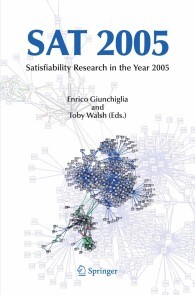
This book is devoted to recent progress made in solving propositional satisfiability and related problems. Propositional satisfiability is a powerful and general formalism used to solve a wide range of important problems including hardware and software verification. The core of many reasoning problems in automated deduction are propositional. Research into methods to automate such reasoning has therefore a long history in artificial intelligence. In 1957, Allen Newell and Herb Simon introduced the Logic Theory Machine to prove propositional theorems from Whitehead and Russel's "Principia mathematica".
In 1960, Martin Davis and Hillary Putnam introduced their eponymous decision procedure for satisfiability reasoning (though, for space reasons, it was quickly superseded by the modified procedure proposed by Martin Davis, George Logemann and Donald Loveland two years later). In 1971, Stephen Cook's proof that propositional satisfiability is NP-Complete placed satisfiability as the cornerstone of complexity theory.
Inhalt
Satisfiability in the Year 2005.- Heuristic-Based Backtracking Relaxation for Propositional Satisfiability.- Symbolic Techniques in Satisfiability Solving.- Exponential Lower Bounds for the Running Time of DPLL Algorithms on Satisfiable Formulas.- Backdoor Sets for DLL Subsolvers.- The Complexity of Pure Literal Elimination.- Clause Weighting Local Search for SAT.- Solving Non-Boolean Satisfiability Problems with Stochastic Local Search: A Comparison of Encodings.- Regular Random k-SAT: Properties of Balanced Formulas.- Applying SAT Solving in Classification of Finite Algebras.- The SAT-based Approach to Separation Logic.- MathSAT: Tight Integration of SAT and Mathematical Decision Procedures.
E-Book Informationen
Ab dem 02.02.2026 wird der bisher verwendete Kopierschutz Adobe DRM durch den Kopierschutz ReadiumLCP ersetzt.
Alle E-Books, die mit einem harten Kopierschutz versehen sind, werden ab diesem Zeitpunkt ausschließlich mit Readium LCP anstelle von Adobe DRM ausgeliefert.
Das Handling von E-Books mit Readium LCP ist für Endnutzer deutlich komfortabler als bisher, da keine zusätzliche ID benötigt wird. Beim ersten Öffnen eines heruntergeladenen Buches wird ein Code angezeigt der von dem Nutzer in ein sich automatisch öffnendes Fenster eingegeben werden muss. Danach lässt sich das E-Book öffnen und lesen.
Ergänzend möchten wir darauf hinweisen, dass PocketBook-Reader den Kopierschutz Readium LCP vollständig unterstützen. Lediglich wenn Readium LCP-geschützte Titel auf einem PC oder Laptop gelesen werden sollen, ist der Thorium Reader erforderlich, der kostenfrei zur Verfügung steht. https://www.edrlab.org/software/thorium-reader/
Bei E-Books die mit Readium LCP geschützt sind erscheint bei dem ersten Öffnen auf ihrem Reader ein Hinweisfenster mit der Aufforderung ein Passwort einzugeben. Gleichzeitig öffnet sich ein Infofeld in dem das Passwort steht. Tragen Sie dieses Passwort in das Eingabefeld ein und bestätigen Sie die Eingabe. Danach öffnet sich das E-Book automatisch. Um E-Books die mit Readium LCP geschützt sind auf einem Tablet/Laptop/Smartphone lesen zu können, benötigen Sie ein Programm, das in der Lage ist, mit diesem Kopierschutz umzugehen. Das ist z.B. der Thorium Reader (Windows, Mac, Linux) oder die PocketBook App (iOS, Android). Fügen Sie das heruntergeladene E-Book in das Programm ein. Bei dem ersten Öffnen erscheint ein Hinweisfenster mit der Aufforderung ein Passwort einzugeben. Gleichzeitig öffnet sich ein Infofeld in dem das Passwort steht. Tragen Sie dieses Passwort in das Eingabefeld ein und bestätigen Sie die Eingabe. Danach öffnet sich das E-Book automatisch